
Ptosis Crutches
Visiting us? See Red Bank hours, parking, and map.
Looking to buy ptosis crutches? Ptosis crutches are usually custom-fitted to eyeglass frames rather than bought off the shelf. Crystal Eyecare offers in-office and remote consultations for selected patients seeking custom ptosis crutches and frame modifications.
If you have been searching for ptosis crutches and coming up empty, you are not alone.
This is a highly specialized service, and many people spend a long time looking for someone who can actually help. At Crystal Eyecare, we provide custom ptosis crutches and frame modifications for selected patients who are looking for a non-surgical option, a bridge while other care is being considered, or a practical eyewear-based solution when local options are limited.
We work with both in-office and remote patients, including people traveling from well outside New Jersey and, in some cases, from outside the United States. If you are reaching out from far away, we understand that this may be a service you have had trouble finding locally.
Our goal is simple. We want to help you understand whether ptosis crutches may be a realistic option for your situation, and if they are, we want to make the process as clear and supportive as possible.
Call now, see what you have been missing.
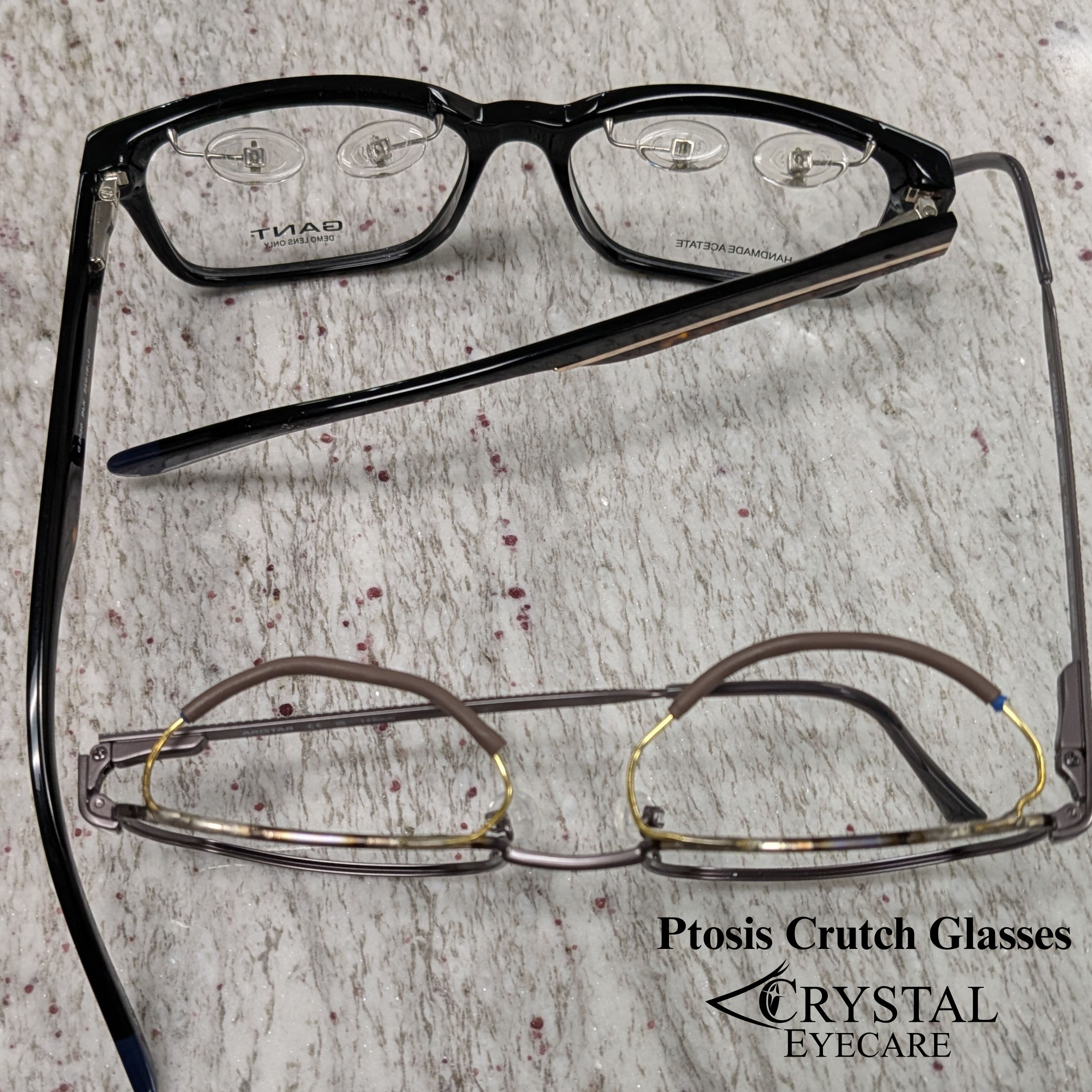
What Are Ptosis Crutches?
Ptosis crutches are custom support bars added to eyeglass frames to help lift a drooping upper eyelid. For the right patient, they can provide a meaningful, non-surgical way to improve visual access and make everyday tasks feel easier.
They are not a one-size-fits-all solution, and they are not ideal for every cause of ptosis. That said, in selected cases they can be a very practical option, especially for patients who are not ready for surgery, are not good surgical candidates, or simply want to explore a more conservative approach first.
Who May Benefit From Ptosis Crutches?
Ptosis crutches may be considered in selected cases involving:
- Age-related or aponeurotic ptosis
- Post-surgical ptosis
- Contact lens-related ptosis
- Mild isolated congenital ptosis in selected cases
- Idiopathic mild acquired ptosis
- Ocular or generalized myasthenia gravis in selected cases
- Chronic progressive external ophthalmoplegia (CPEO)
- Myogenic ptosis associated with muscular dystrophies in selected cases
- Stable chronic third cranial nerve palsy
- Mild Horner syndrome
- Mechanical ptosis from dermatochalasis or brow ptosis
- Temporary support in selected trauma-related or mass-related eyelid problems
The underlying cause of eyelid droop matters. Ptosis crutches are best viewed as a specialty eyewear support option, not a universal answer for every patient or diagnosis.
Why Patients Choose Ptosis Crutches
Many patients are looking for something practical. They want to see more comfortably, keep their daily routine manageable, and avoid feeling like surgery is the only path forward. Ptosis crutches can be appealing because they are:
- Non-surgical
- Custom-fitted to the frame and patient
- Adjustable in most cases
- Sometimes useful as a bridge while other care is being considered
- Helpful for patients who cannot easily find this service locally
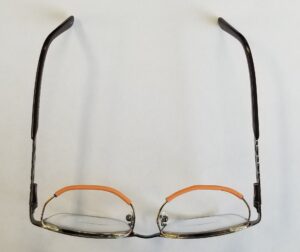 Ptosis crutches top view
Watch Our Ptosis Crutch Videos
If you would like to see how ptosis crutches work in real life, these videos are a good place to start:
Ptosis crutches: What are they?
How Does a Ptosis Crutch Work?
The support bar acts as a gentle wedge between the eyelid tissue and the frame. Depending on lid anatomy and the amount of excess tissue present, the lid may drape over the bar in a way that helps improve visual access.
In the right situation, this can make a real difference in day-to-day comfort and function. The key is thoughtful fitting, realistic expectations, and using a frame that can actually support the modification properly.
In-Office Ptosis Crutch Fittings
The easiest and most precise way to receive this service is through an in-office visit at Crystal Eyecare. Seeing you in person allows us to evaluate eyelid position, frame fit, support needs, and overall comfort more carefully.
If you are able to visit, we can help determine whether your current frame is suitable or whether another frame style would work better for this modification.
Remote Ptosis Crutch Consultations for Selected Patients
We know many people looking for this service are not nearby. For selected patients, a remote process may be possible.
To begin, please
fill out this intake form
and email it to us at crystaleyecarenj@gmail.com.
With the intended frame on, please provide:
- A right-side profile photo
- A left-side profile photo
- A photo looking at distance
- A 1-minute video so we can observe lid position and movement
- Your diagnosis, if known
- The frame size measurements, if available
A short video is especially helpful when there is concern about fluctuating lid position, blepharospasm, or other complex eyelid behavior.
Frame Requirements and Material Considerations
High-quality metal frames generally work best for ptosis crutch modifications. Frames with better soldering characteristics are preferred. Stainless steel may sometimes work as a second choice.
Titanium is generally not appropriate for this type of modification, and many low-cost alloy frames are poor candidates. Frames from mass-market online sources may not solder well enough for dependable results.
It cannot be emphasized enough that the frames have to be high quality. In some cases, a frame strap with rubber tips may also help maintain a more stable frame position and improve comfort.
Important Limitations and Expectations
Ptosis crutches can be very helpful in the right case, but they are not ideal for every patient. Comfort, blink quality, lid anatomy, frame compatibility, and the underlying cause of ptosis all matter.
Some patients ask whether ptosis crutches may help in cases involving blepharospasm or other complex eyelid conditions. In our experience, results can be mixed, and expectations should be discussed honestly on a case-by-case basis.
For background information, see the National Eye Institute page on blepharospasms.
See More Examples
View our Ptosis Crutch Gallery to see more examples of this specialty frame modification.
Common Questions About Ptosis Crutches
Are ptosis crutches only for age-related ptosis?
No. They may also be considered in selected cases involving post-surgical ptosis, some neuro-ophthalmic conditions, some myogenic conditions, and some mechanical causes of eyelid droop.
Are ptosis crutches a substitute for surgery?
Not always. For some patients, they are a conservative alternative. For others, they may serve as a bridge while medical or surgical options are being considered.
Can you fit ptosis crutches remotely?
In selected cases, yes. Photos, video, and frame review help us determine whether a remote fitting is realistic, filling out the form helps a lot.
What frames work best?
High-quality metal frames generally work best for this type of modification. It cannot be titanium. Stainless steel may work, but know that the steel’s temper (the temperature used to give strength and elasticity) may change.
Do ptosis crutches help every patient with drooping eyelids?
No. The cause of the ptosis, the anatomy of the eyelid, frame fit, and the patient’s goals all affect whether this option is likely to be useful.
Request a Ptosis Crutch Consultation
If you are looking for custom ptosis crutches or frame modifications, contact Crystal Eyecare to discuss whether
this specialty eyewear service may be appropriate for your needs.
Call now, see what you have been missing.